

ReleasePad launches MCP server so Claude, Codex and Cursor can write your product release notes for you.
Explanatory image
ReleasePad launches an MCP server so AI coding agents can write your product releases notes for you. You approve; it publishes everywhere.
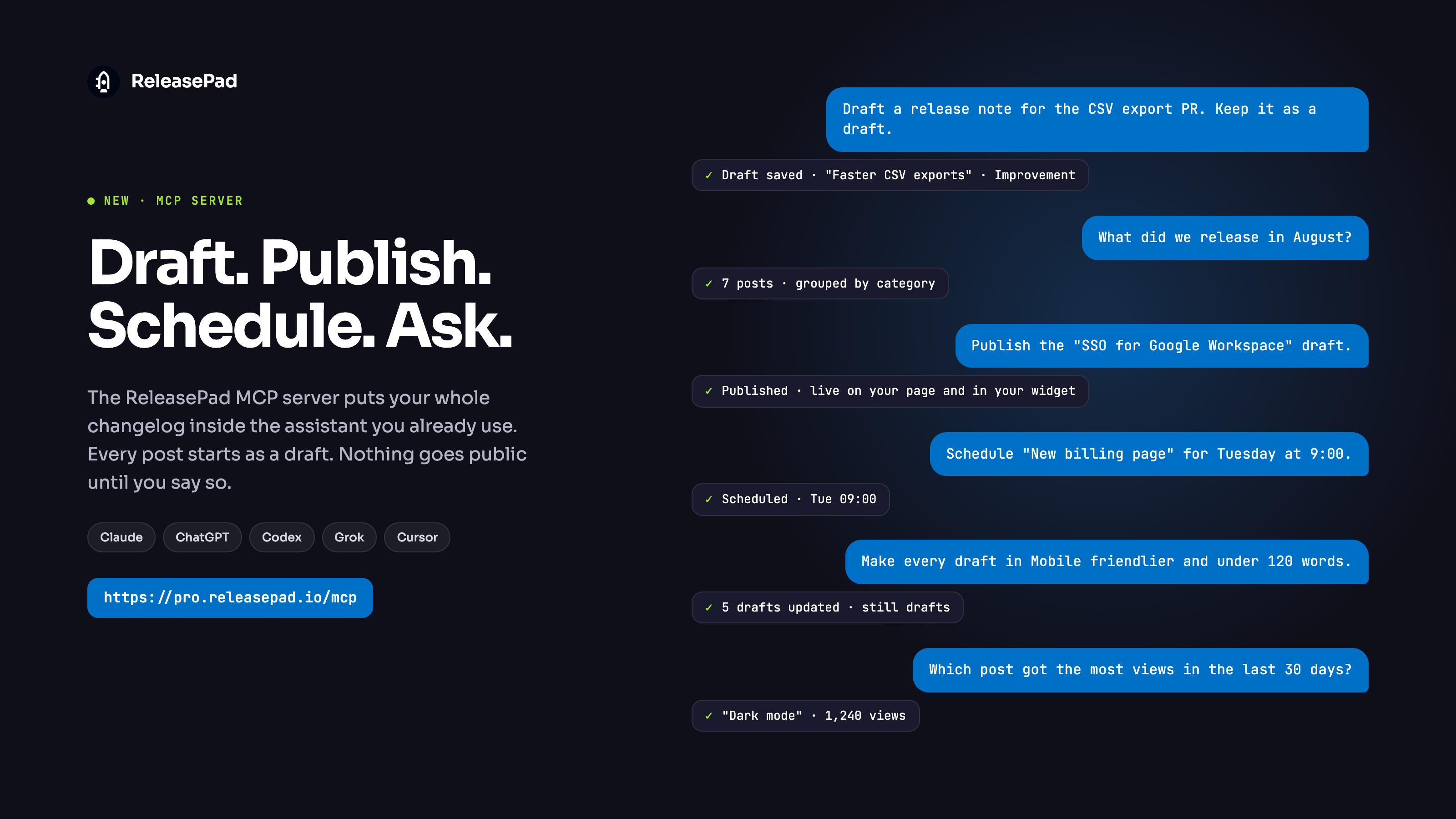
NEWARK, DE, UNITED STATES, September 14, 2026 /EINPresswire.com/ -- Release notes are the step most product teams skip. The feature ships, the announcement waits, and customers never hear about it. The work is done, the pull request is merged, and the one task that would tell anyone about it sits on a to-do list until it stops mattering.ReleasePad, a changelog tool, today launched a Model Context Protocol (MCP) server so the AI coding assistant a team already works in, such as Claude, Codex or Cursor, can take that step for them. The server is live at pro.releasepad.io/mcp and works with any assistant that supports the protocol.
The step that never gets done
Most product teams ship every week. Very few announce every week. The gap is not a lack of tools for writing announcements; it is that writing them is nobody's job. The engineer who built the feature has moved on to the next one. The product manager is in planning. The marketer does not know it shipped. So the changelog goes quiet, users assume the product has stalled, and support fields questions that a two-line note would have answered.
Teams have started using AI coding assistants to draft these notes, pasting in commit messages and asking for a summary. That fixes the writing. It does not fix the forgetting, and it still leaves someone to copy the result into a changelog, pick a category, and hit publish.
What the MCP server does
The Model Context Protocol is an open standard that lets AI assistants use external tools. ReleasePad's MCP server exposes the changelog as a set of those tools, so the assistant a developer already has open can act on it directly.
Ask it to look at what was merged this week and it drafts a customer-ready note in the team's voice, files it under the right category and schedules it. It can create posts as drafts, edit or reference earlier ones, list a product's categories, attach images, and report how each post performed once it is live. A typical request is a single sentence: "Look at what we merged this week, draft a release note for customers, and leave it as a draft for me to review."
Connection takes one sign-in. The server authenticates through OAuth, so there are no API keys to generate, paste or rotate, and access can be revoked from the account like any other connected app.
The same connection works in the other direction. Because the server exposes ReleasePad's analytics, an assistant can answer questions like "how many people read last week's post?" or "which of our September updates got the most views?" without anyone opening a dashboard. Teams can use that to decide what to announce next, or to notice that a feature they thought was obvious went unread.
People keep the last word
Every draft waits for a person to approve it; nothing goes out until someone presses publish. The assistant can prepare as much as a team wants, but the changelog never changes without a human decision. Teams that want more control over the writing itself can set the tone, language, detail level and emoji style in their AI settings, and add free-text instructions such as "always mention which plans the change applies to" that are included every time a note is generated.
One approval, three places
Once approved, the update reaches customers in the in-app widget, on a changelog page on the company's own domain, and as an LLM-ready Markdown feed AI assistants can read.
The in-app widget is a 4.3-kilobyte script that shows a "What's new" panel inside the product, so users see the update while they are working rather than in an email they will not open. The public changelog page is hosted on the customer's own subdomain, such as updates.yourdomain.com, with HTTPS handled automatically, and is built to be indexed by search engines. The Markdown feed publishes the same entries in a format that ChatGPT, Claude, Perplexity and other assistants can read, so when a prospect asks one of them whether the product does something, the answer comes from the team's own release notes instead of a guess.
That last surface is what makes the launch more than a writing shortcut. The same kind of AI that helped build a feature now announces it, and the AI that customers consult reads the announcement. The loop between shipping and being seen closes without anyone having to remember it.
Who it is for
The launch is aimed at small and mid-sized software teams that ship often and have no one whose job is to write about it: indie developers, solo founders, and product teams of a few dozen people where engineers, product managers and support share the work of talking to customers. For these teams the changelog is usually the first thing to fall behind when the roadmap gets busy, and the first place a prospect looks to judge whether a product is still alive.
It also fits teams that have adopted AI coding agents. When an agent writes a meaningful share of the code, the announcement lagging behind is a bigger gap than before, because features arrive faster than anyone is writing about them. Giving the same agent a way to file the release note closes that gap in the same session the code was written.
From the company
"Writing the note was never the hard part. Remembering to was," said Felix, CEO of ReleasePad. "Now it's one sentence to your assistant. It reads what you shipped, writes it the way you would, and waits for you to say yes. The part of the job that always slipped is the part that no longer needs a person to start it."
Felix Macx
ReleasePad
email us here
Legal Disclaimer:
EIN Presswire provides this news content "as is" without warranty of any kind. We do not accept any responsibility or liability for the accuracy, content, images, videos, licenses, completeness, legality, or reliability of the information contained in this article. If you have any complaints or copyright issues related to this article, kindly contact the author above.
