

RadioCult Breaks Down What to Look For in Online Radio Analytics

RadioCult's real-time analytics, showing live and historical listener activity, unique and peak listeners, session trends, and device and OS breakdowns, with data stations can export for sponsors and grants.
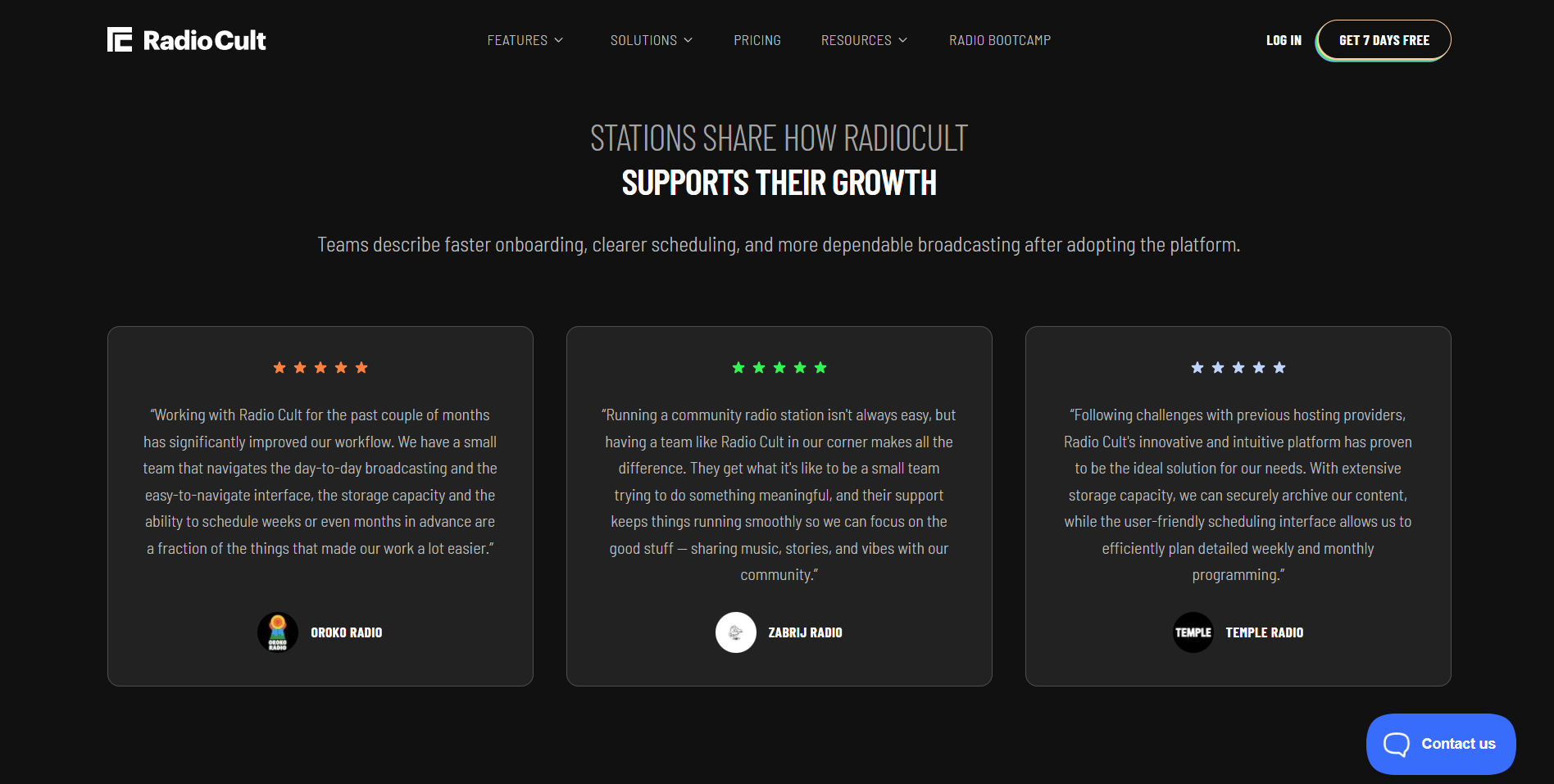
Independent and community stations, including Oroko Radio, Zabrij Radio, and Temple Radio, describe faster onboarding, clearer scheduling, and more dependable broadcasting with RadioCult.

The RadioCult homepage, where broadcasters can start a 24/7 online radio station with scheduling, live and automated broadcasting, and unlimited concurrent listeners.
Where the data comes from, how far back it goes, and whether it respects listener privacy: the things that matter most when comparing online radio analytics.
The first thing to check is where the data comes from. Analytics measured at the audio stream source give a clearer picture of real listening than numbers inferred by third-party trackers bolted onto a website. Stream-source tracking also tends to be more privacy-conscious, because it counts listening activity without following individual people around the internet.
The second is what the numbers actually cover. Useful online radio analytics go beyond a single listener count to show unique and peak listeners, session counts, total listener hours, and average session length, broken down by country and city and by device and operating system. That combination is what lets a station see not just how many are listening, but who, where, and for how long.
The third is how far back the history goes. A single live snapshot is useful in the moment, but trends need time. RadioCult retains twelve months of historical listener data, a longer window than many platforms keep, which lets a station compare seasons, show the growth of a program over a year, and export a full picture into a sponsor deck or grant application.
"Most stations do not need more numbers, they need numbers they can trust and actually use," said a RadioCult spokesperson. "Where the data comes from, how far back it goes, and whether it respects your listeners are the questions that decide whether analytics help you grow or just fill a dashboard."
The fourth is privacy. Stations, especially community and independent ones operating in privacy-conscious regions, increasingly need analytics that do not harvest personal listener data or rely on invasive tracking pixels. Analytics that report station-level activity, devices, and locations, rather than individual listener profiles, keep a station on the right side of that line. The fifth is whether the data leaves the platform: exportable reports turn listening figures into something a station can hand to a sponsor, a grant body, or its own team.
RadioCult's real-time and historical analytics bring these together as online radio analytics with stream-source tracking, twelve months of history, location and device breakdowns, and exportable reports, alongside a privacy-conscious approach to radio listener analytics. Its analytics feature and its guide to how listener analytics work are available on its website.
About RadioCult
RadioCult is an online radio hosting platform built for independent and community stations that broadcast 24/7 with multiple presenters. It combines live and automated broadcasting, radio-native scheduling, station and artist management, and unlimited concurrent listeners in one platform, with human support and pricing that starts at $33 per month. Learn more at https://www.radiocult.fm.
Corey Haines
Conversion Factory
email us here
Visit us on social media:
Instagram
Facebook
X
Legal Disclaimer:
EIN Presswire provides this news content "as is" without warranty of any kind. We do not accept any responsibility or liability for the accuracy, content, images, videos, licenses, completeness, legality, or reliability of the information contained in this article. If you have any complaints or copyright issues related to this article, kindly contact the author above.
