

SHIRO & Co. Connects Observation and Proposal Systems With an ALLOW / HOLD / DENY Boundary
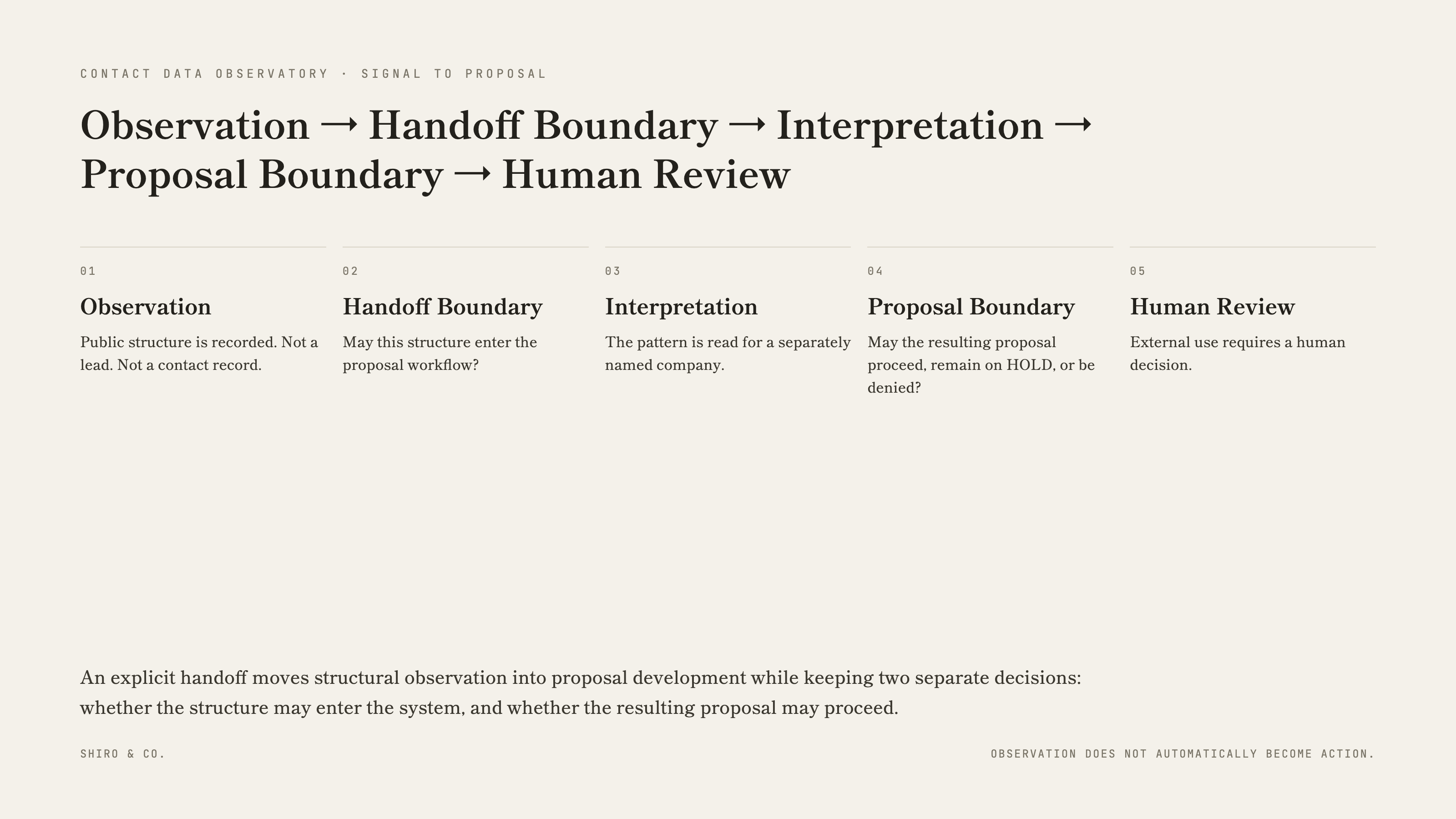
An explicit handoff moves structural observation into proposal development while keeping two separate decisions: whether the structure may enter the system and whether the resulting proposal may proceed.
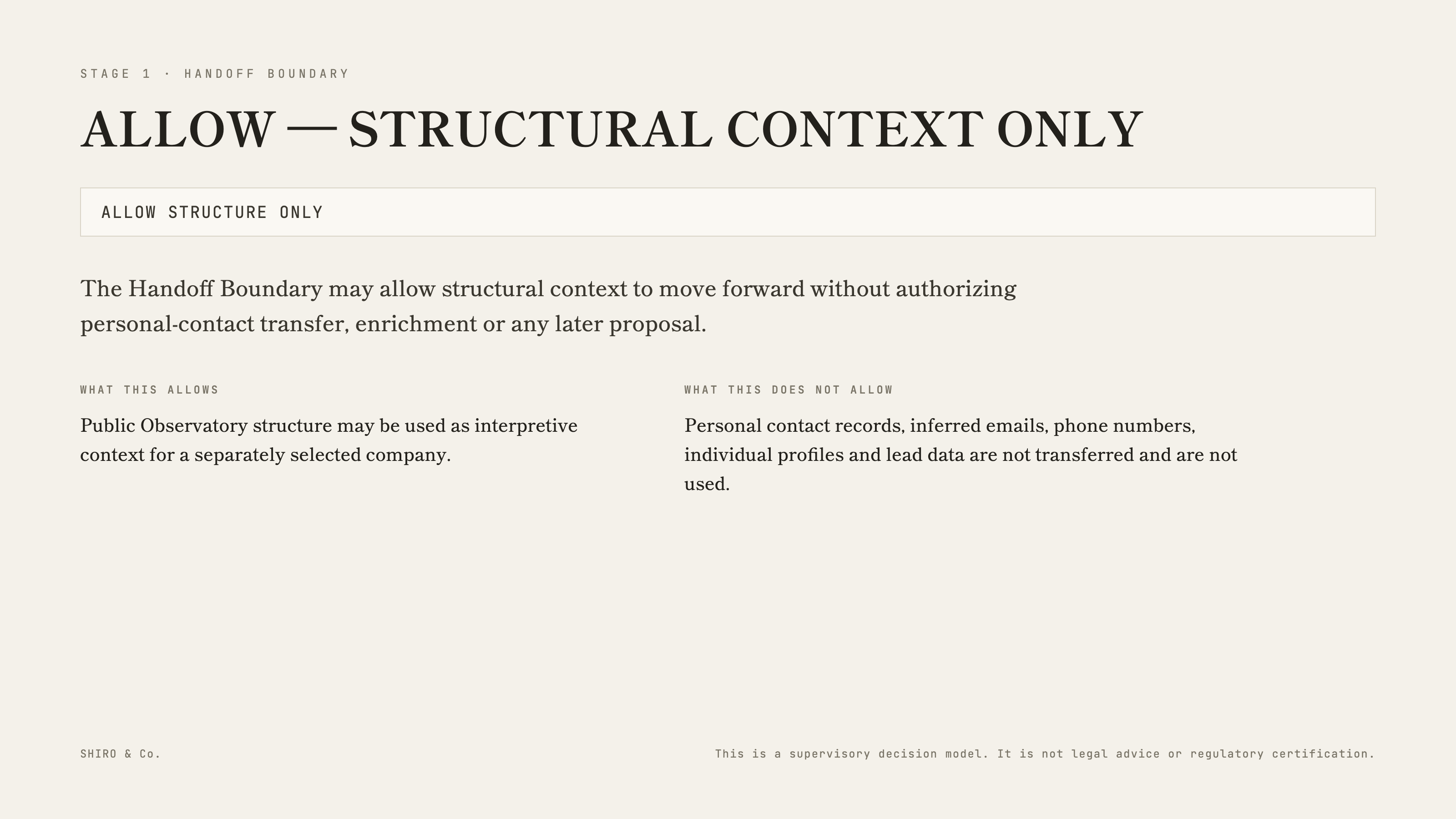
The Handoff Boundary may allow structural context to move forward without authorizing personal-contact transfer, enrichment or any later proposal.
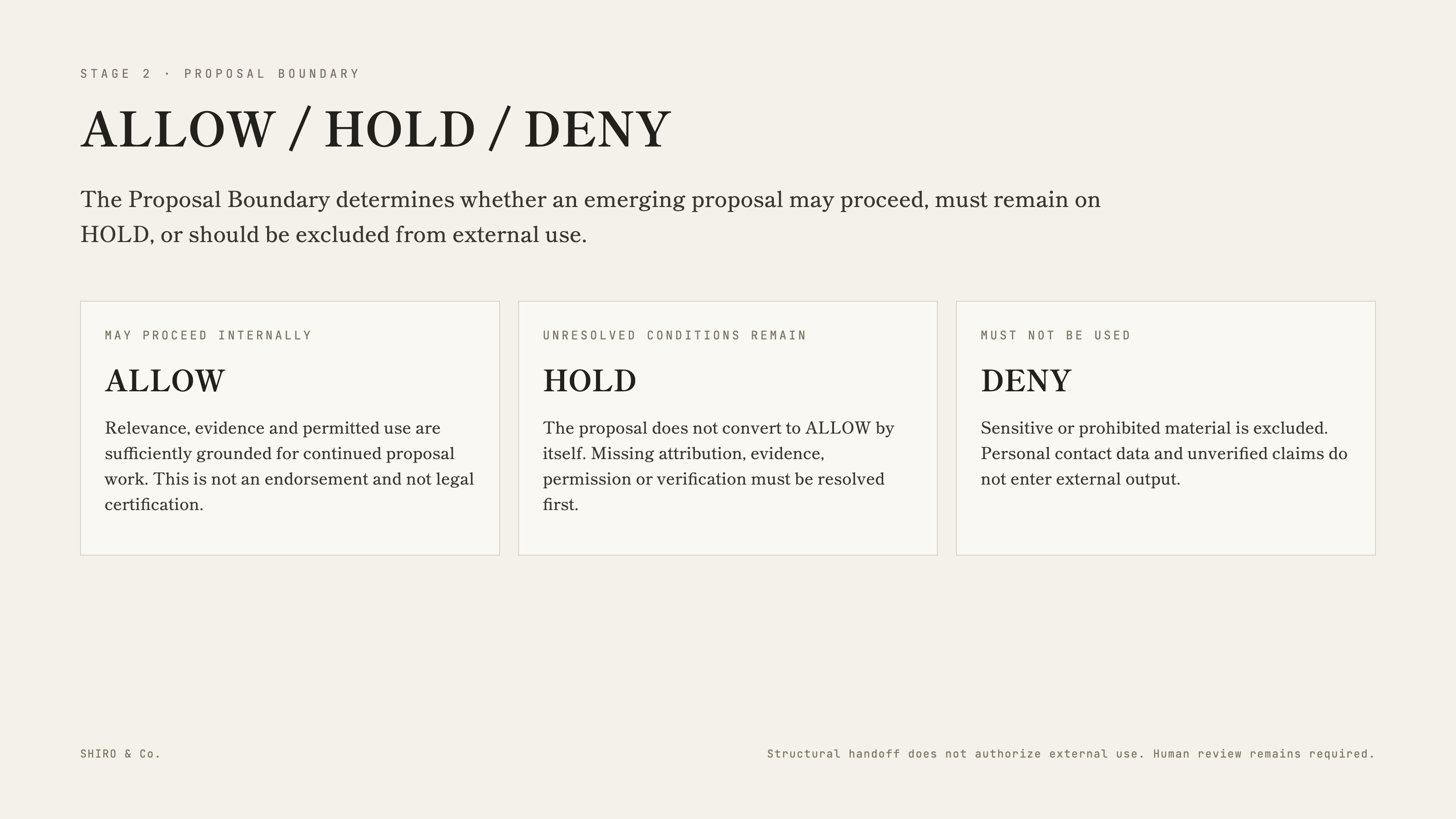
The Proposal Boundary determines whether an emerging proposal may proceed, must remain on HOLD, or should be excluded from external use.
The Kosuke Protocol preserves provenance, permission and uncertainty as structural observations move into proposal development and human review.
TOKYO, OTA, JAPAN, September 16, 2026 /EINPresswire.com/ -- SHIRO & Co., a Tokyo-based Observation & Protocol Studio, has implemented a supervised handoff between its Contact Data Observatory and proposal-development system, connecting structural observation with proposed business action while preserving provenance, permission and uncertainty.
The implementation extends the Kosuke Protocol through a six-stage workflow:
OBSERVE → HANDOFF BOUNDARY → INTERPRET → PROPOSAL BOUNDARY → HUMAN REVIEW → PROPOSED NEXT ACTION
The connection is explicit rather than automatic. A user selects a structural observation from an Observatory record and deliberately sends that structure into Signal to Proposal. The handoff carries source facts, observed transformation, provenance, usage cautions and verification requirements. It does not transfer a lead, personal contact record or endorsement of any later proposal.
“Observation should not automatically become action,” said Kosuke Shirako, founder of SHIRO & Co. “The moment a signal enters a proposal workflow, the system should still know where it came from, what was observed, what was inferred, what may be used and what requires human judgment.”
TWO BOUNDARIES BETWEEN OBSERVATION AND ACTION
The workflow separates two decisions.
The Handoff Boundary determines whether an observed structure may enter the proposal system. It evaluates source, identity, permission, fact versus inference, provenance, scope, sensitivity and payload validity.
For a public structural observation containing no personal contact data, the system may return:
ALLOW — STRUCTURAL CONTEXT ONLY
This means the observed pattern may be used as interpretive context. It does not permit the transfer, enrichment or use of personal contact data, and it does not approve any resulting proposal.
The Proposal Boundary is applied after a target company, business concern and relevant signals have been identified. It determines whether the emerging proposal is sufficiently grounded, relevant and appropriate for external use.
The Proposal Boundary can ALLOW progress, place the proposal on HOLD for additional evidence or human review, or DENY progression when the proposed use falls outside the permitted scope. HOLD does not automatically become ALLOW.
STRUCTURE, NOT A LEAD
The initial public demonstration begins with a Contact Data Observatory record examining RocketReach as an observed contact-data infrastructure.
RocketReach is used only as an observation target. SHIRO & Co.’s registry does not reproduce or collect personal contact records, and no relationship with or endorsement by RocketReach is implied.
When a user selects Send Structure to Proposal, the receiving system preserves the Observation ID and distinguishes:
Primary source facts
Observatory observations
System interpretations
The receiving screen also states what must be verified before external use and what must not be used, including personal contact records, inferred email addresses, phone numbers, individual profiles, lead records and unverified claims about a person or target company.
After the handoff, the observed company is not automatically treated as the proposal target. The user must separately identify the company or organization for which the structural pattern will be interpreted.
“A company appearing in an Observatory is not automatically a sales target,” Shirako said. “We are moving a structure across the boundary, not a person.”
FROM MARKET CHANGE TO COMPANY-SPECIFIC OPPORTUNITY
Signal to Proposal applies the Kosuke Protocol through five reasoning stages:
Signal → Structure → Meaning → Opportunity → Proposal
The purpose is not to summarize news or generate the same recommendation for every company. The system keeps the originating structural observation separate from company information entered later in the workflow and retains provenance and usage cautions as the proposal develops.
The implementation uses curated handoff rather than automatic live ingestion. Individual observations can be transferred deliberately, while the Observatory as a whole is not continuously imported into the proposal system.
A SEPARATE CUSTOMER PATH
Customer to Proposal is a separate entry point for authorized customer-conversation records.
It separates what was stated, what was observed, what the system inferred, what must be verified and what must not be used. Observatory material can be added only through explicit user action and remains labeled OBSERVATORY STRUCTURE rather than CUSTOMER FACT.
Generated proposal material remains subject to human inspection and adjustment before external use. The current interface uses ephemeral processing and instructs users to submit only conversation data they are authorized to process.
THE SUPERVISORY LAYER IN PRACTICE
The implementation applies SHIRO & Co.’s Supervisory Layer concept to the movement from observation toward enterprise action.
HOLD is used as an intermediate supervisory state when provenance is incomplete, permission is unclear, evidence is insufficient or a human decision is still required.
AI or automation may assist with interpretation and proposal formation, but it does not acquire authority merely because it can produce an output.
The operating principle is:
Observation does not automatically become action. Structural handoff does not authorize external use.
ALLOW, HOLD and DENY are supervisory states used within SHIRO & Co.’s applied research framework. They are not presented as legal certification, regulatory standards or universal industry requirements.
POTENTIAL APPLICATION AREAS
The implementation examines areas including market and regulatory signal interpretation, event follow-up, existing-customer development, partner and distributor proposal support, consulting workflows and organization-specific proposal governance.
Company-specific configurations may incorporate approved internal knowledge, decision criteria, review rules and operating context while retaining boundaries around provenance, permission and human authority.
PRESS DEMONSTRATION
A controlled press demonstration presents the workflow without providing direct access to the live production interfaces.
Press Demonstration:
https://www.shiroand.io/signal-customer-to-proposal
ABOUT SHIRO & CO.
SHIRO & Co. is an independent Observation & Protocol Studio based in Tokyo. The company studies structural change across society, markets, technology and everyday human activity and develops systems, frameworks and applied forms from those observations.
Its shared foundation is the Kosuke Protocol.
SHIRO & Co.
https://www.shiroand.io
SHIRO & Co. Journal
https://journal.shiroand.io
KOSUKEMAIKO SHIRAKO
SHIRO & Co.
+ +81 80-1269-5473
email us here
Visit us on social media:
LinkedIn
Legal Disclaimer:
EIN Presswire provides this news content "as is" without warranty of any kind. We do not accept any responsibility or liability for the accuracy, content, images, videos, licenses, completeness, legality, or reliability of the information contained in this article. If you have any complaints or copyright issues related to this article, kindly contact the author above.
