
The most trusted news from Europe
Provided by AGP
Freeform terahertz structures fabricated by multi-photon lithography and metal coating
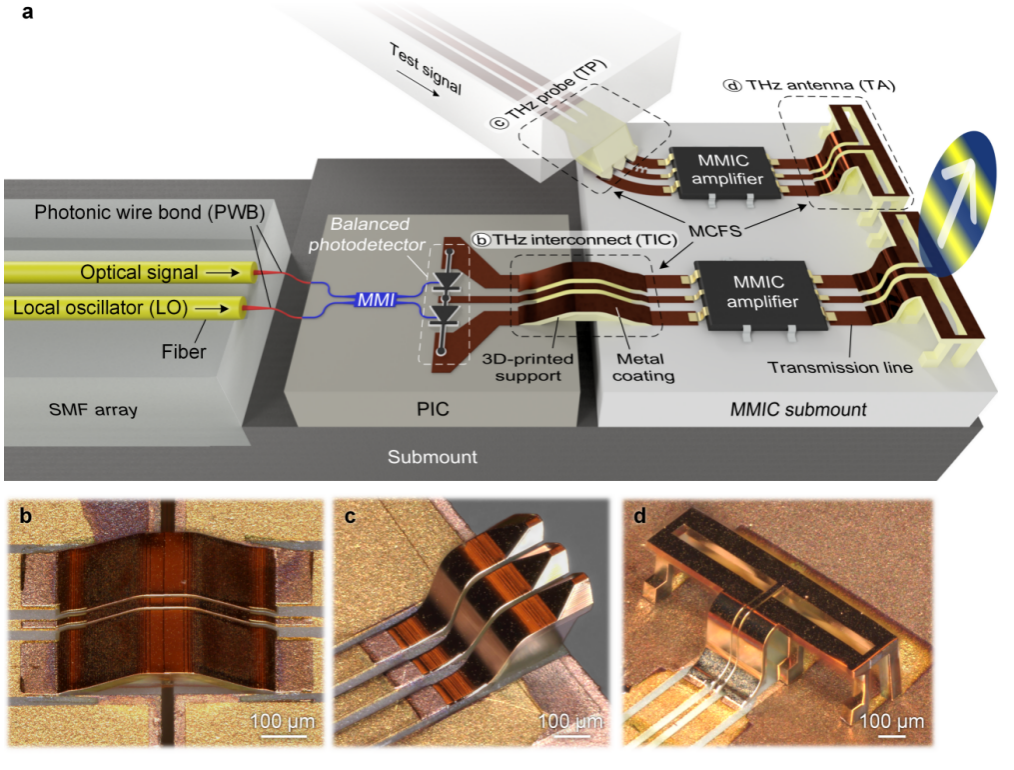
Next-Generation Terahertz Systems via 3D Printing.
GA, UNITED STATES, May 14, 2026 /EINPresswire.com/ -- Researchers have developed a novel method to fabricate high-performance terahertz devices directly on chips. The technique combines multi-photon 3D-printing with selective metal coating to create smooth, highly conductive structures with sub-micrometer precision. It enables complex 3D-geometries, does not require costly mechanical assembly steps, and supports a wide range of applications including broadband chip-to-chip connections, freeform probes, and suspended antennas operating beyond 0.3 THz. The approach could significantly advance terahertz communications, sensing, as well as test & measurement equipment.
The terahertz (THz) and millimeter-wave (mmW) frequency range holds immense potential for ultra-high-speed wireless communications, advanced sensing, and ultra-broadband signal processing. Leveraging this potential, however, requires advanced THz devices that combine highly conductive metal elements with low-loss dielectrics in precisely defined three-dimensional (3D) freeform geometries. Manufacturing such structures is a challenge that conventional techniques struggle to meet, typically requiring complex manual assembly or falling short of providing the bulk-like electrical conductivity and sub-micrometer precision needed for high-performance THz devices.
In a new paper(doi: https://doi.org/10.37188/lam.2026.036) published in Light: Advanced Manufacturing, a team of scientists at Karlsruhe Institute of Technology (KIT), Germany, led by Professor Christian Koos and co-workers, have developed a transformative approach to overcome these fabrication hurdles. Their technique relies on so-called "metal-coated freeform structures" (MCFS), manufactured by a scalable method that uniquely combines the essentially unlimited 3D design freedom of direct-write multi-photon lithography with highly directive metal deposition techniques. Based on this technique, the team successfully demonstrated a series of high-performance THz components that are directly integrated on chips with sub-micrometer precision. The researchers achieved ultra-broadband chip-to-chip connections, cost-effective probe tips, and suspended on-chip antennas operating at frequencies of up to 0.3 THz.
The scientists summarize the operational principle of their method: “Our concept exploits in-situ printed polymer support structures, that are selectively coated through highly directive metal deposition techniques exploiting precisely aligned 3D-printed shadowing structures”. They emphasize that the resulting structures “offer high surface quality in combination with conductivities comparable to bulk material values of the respective metal and do not require any manual assembly steps”. By enabling the seamless integration of highly conductive elements with microscopic precision, the MCFS approach drastically reduces the cost and complexity of producing THz systems while maintaining sub-micrometer accuracy. "We believe that our approach offers disruptive potential in the field of mmW and THz technology and may unlock an entirely new application field for laser-based 3D manufacturing," the scientists forecast. This breakthrough will open new avenues for ultra-fast communications, advanced sensing, and chiplet-based THz systems.
DOI
10.37188/lam.2026.036
Original Source URL
https://doi.org/10.37188/lam.2026.036
Funding information
This work was supported by the Deutsche Forschungsgemeinschaft (DFG, German Research Foundation) via the Excellence Cluster 3D Matter Made to Order (EXC2082/1–390761711), via the DFG Collaborative Research Center HyPERION (SFB 1527), and via the projects PACE (#403188360) and GOSPEL (#403187440) within the Priority Programme “Electronic-Photonic Integrated Systems for Ultrafast Signal Processing” (SPP 2111), by the ERC Consolidator Grant TeraSHAPE (#773248), by the EU Horizon 2020 project TeraSlice (#863322), by the European Innovation Council (EIC) transition project HDLN (#101113260), by the BMBF project Open6GHub (#16KISK010), by the Alfried Krupp von Bohlen und Halbach Foundation, and by the Karlsruhe School of Optics & Photonics (KSOP).
Lucy Wang
BioDesign Research
email us here
Legal Disclaimer:
EIN Presswire provides this news content "as is" without warranty of any kind. We do not accept any responsibility or liability for the accuracy, content, images, videos, licenses, completeness, legality, or reliability of the information contained in this article. If you have any complaints or copyright issues related to this article, kindly contact the author above.
