

Germany Insurance Consulting Market Expands; Allianz and Munich Re Lead
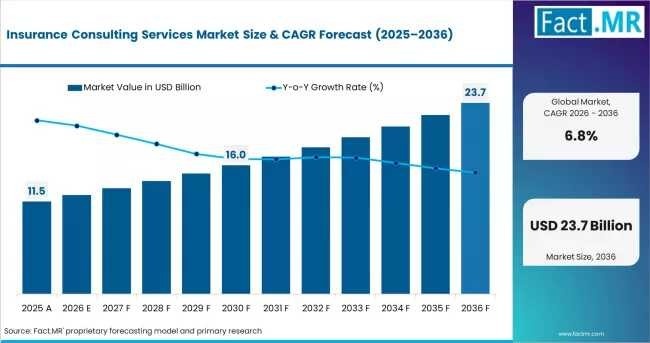
Insurance Consulting Services Market
ESG mandates and regulatory compliance reshape consulting demand
ROCKVILLE, MD, UNITED STATES, April 17, 2026 /EINPresswire.com/ -- The German insurance consulting services market is undergoing a structural transformation, evolving from a traditional cost center into a critical strategic investment for long-term resilience. According to the latest analysis by Fact.MR, the market was valued at USD 10.8 billion in 2025 and is projected to reach USD 11.5 billion in 2026. Maintaining a steady CAGR of 6.0% for the German region, the market is set to soar to a forecast value of USD 22.3 billion by 2036.The market’s expansion is underpinned by a relentless cycle of regulatory updates from BaFin and the integration of Environmental, Social, and Governance (ESG) frameworks. As insurers navigate the complexities of Solvency II and IFRS 17, the demand for specialized risk management and Own Risk and Solvency Assessment (ORSA) expertise has become a non-negotiable requirement for industry leaders.
Get detailed market forecasts, competitive benchmarking, and pricing trends:
https://www.factmr.com/connectus/sample?flag=S&rep_id=14740
Quick Stats Section
Market Size (2025): USD 10.8 Billion
Market Size (2026E): USD 11.5 Billion
Forecast Value (2036F): USD 22.3 Billion
Germany CAGR:0% (2026–2036)
Incremental Opportunity: USD 10.8 Billion (Global)
Leading Segment: Risk & Compliance Consulting (35% Share)
Leading End User: Insurance Companies (63% Share)
Key Players: Deloitte, PwC, EY, KPMG, Accenture, McKinsey & Company, Aon, Marsh McLennan
Executive Insight for Decision Makers
The insurance consulting landscape is shifting from "broad advisory" to "embedded execution." For C-suite executives at German insurers, the era of standalone strategy slides is over.
The Strategic Shift: Consulting mandates are now tethered to technology implementation. Success is measured by how well a firm integrates AI-driven underwriting or cloud-based claims automation within existing regulatory guardrails.
The Mandate for Manufacturers/Investors: Firms must develop integrated digital-regulatory capabilities. Investors should prioritize consulting entities that offer outcome-linked mandates rather than traditional retainers.
Risks of Stagnation: Carriers that fail to outsource core system modernization risk falling behind in operational efficiency, facing higher capital requirements due to outdated risk modeling.
Market Dynamics
Key Growth Drivers:
BaFin Regulatory Intensity: Increasing requirements for risk management and governance are forcing insurers to seek external actuarial depth.
ESG and Sustainability Reporting: New EU-wide mandates for non-financial reporting are creating a multi-year consulting cycle.
Digital Core Modernization: The push to replace legacy systems with cloud-native platforms is driving massive discretionary spend.
Key Restraints:
Internal Capability Build-up: Larger German carriers are increasingly developing in-house "Centers of Excellence," reducing the need for external generalist advisory.
Fee Pressure: Mature market dynamics are leading to squeezed margins on standard compliance tasks.
Emerging Trends:
AI-Based Regulatory Tracking: Transitioning from manual audits to real-time compliance monitoring.
Insurtech Partnerships: Consulting firms acting as "bridge builders" between traditional carriers and niche tech startups.
Segment Analysis
Service Type Leadership:Risk & Compliance Consulting holds a 35% share in 2026. This is driven by the sheer complexity of cross-border solvency requirements that internal teams cannot manage alone.
End-User Dominance:Insurance Companies represent 63% of the market, primarily focusing on large-scale actuarial and digital transformation projects.
Property & Casualty (P&C): This remains the leading insurance type due to the heightened need for catastrophe risk modeling and claims complexity.
Supply Chain Analysis: The "Advisory-to-Execution" Flow
The supply chain for insurance consulting is specialized and increasingly high-tech:
Knowledge Providers: Academic institutions and regulatory bodies (BaFin, IAIS) provide the "raw material" of standards and frameworks.
Primary Producers: Firms like Deloitte, PwC, and EY transform these regulations into actionable compliance models.
Technology Partners: Cloud providers (AWS, Azure) and core system vendors (Guidewire) supply the infrastructure that consultants implement.
End-Users: Global giants like Allianz and Munich Re buy these integrated services to de-risk their operations and accelerate time-to-market for new products.
Pricing Trends
The market is seeing a move toward performance-linked pricing.
Commodity vs. Premium: Basic audit and tax compliance are becoming commoditized. In contrast, implementation-accountable engagements command 20–40% fee premiums.
Margin Insights: Higher margins are currently found in IFRS 17 and ESG advisory, where specialized talent is scarce and the value of "getting it right" is immense for the carrier’s share price.
Competitive Landscape
The market structure is consolidated at the top, with the "Big Four" and top-tier strategy firms capturing the lion's share of high-value mandates.
Regulatory Leaders:Deloitte and PwC lead in regulatory-heavy programs, leveraging their actuarial depth.
Transformation Leaders:Accenture and McKinsey are capturing the technology implementation space, focusing on cloud underwriting and AI automation.
Strategy: Firms are increasingly acquiring niche tech-advisory players to provide a "one-stop-shop" for German insurers.
Strategic Takeaways
For Manufacturers/Service Providers: Build dedicated insurance practices that focus on "implementation ownership" rather than just strategy.
For Investors: Focus on firms with strong delivery capabilities in the India and China corridors, where CAGRs are highest (8.0% and 7.5% respectively).
For Marketers: Emphasize "regulatory safety" and "digital agility" as a combined offering.
Future Outlook
The long-term opportunity lies in Sustainability and AI Governance. As German insurers move toward 2036, the focus will shift toward managing the "risk of the machines"—ensuring that AI-driven underwriting remains compliant, ethical, and transparent. Consulting firms that master this intersection will dominate the next decade.
Conclusion
Germany’s insurance consulting market is at a crossroads. As Allianz and Munich Re expand their consulting engagements to meet ESG and digital mandates, the industry is proving that external expertise is no longer a luxury—it is an operational necessity. The firms that win will be those that can turn regulatory "red tape" into a competitive digital "fast track."
Why This Market Matters:
Insurance is the bedrock of economic stability. As global risks—from climate change to cyber warfare—intensify, the consulting services that guide these financial giants ensure the entire economy remains insurable and resilient.
Full Report: Unlock 360° insights for strategic decision making and investment planning-
https://www.factmr.com/checkout/14740
To View Related Report:
Drone Services Market https://www.factmr.com/report/drone-services-market
Fire Safety Services Market https://www.factmr.com/report/fire-safety-services-market
Smart Drone Services Market https://www.factmr.com/report/smart-drone-services-market
Aerial Video Services Market https://www.factmr.com/report/aerial-video-services-market
S. N. Jha
Fact.MR
+1 628-251-1583
email us here
Legal Disclaimer:
EIN Presswire provides this news content "as is" without warranty of any kind. We do not accept any responsibility or liability for the accuracy, content, images, videos, licenses, completeness, legality, or reliability of the information contained in this article. If you have any complaints or copyright issues related to this article, kindly contact the author above.
