

Germany Line-Level AI Optimization Market Grows; Siemens and Bosch Lead
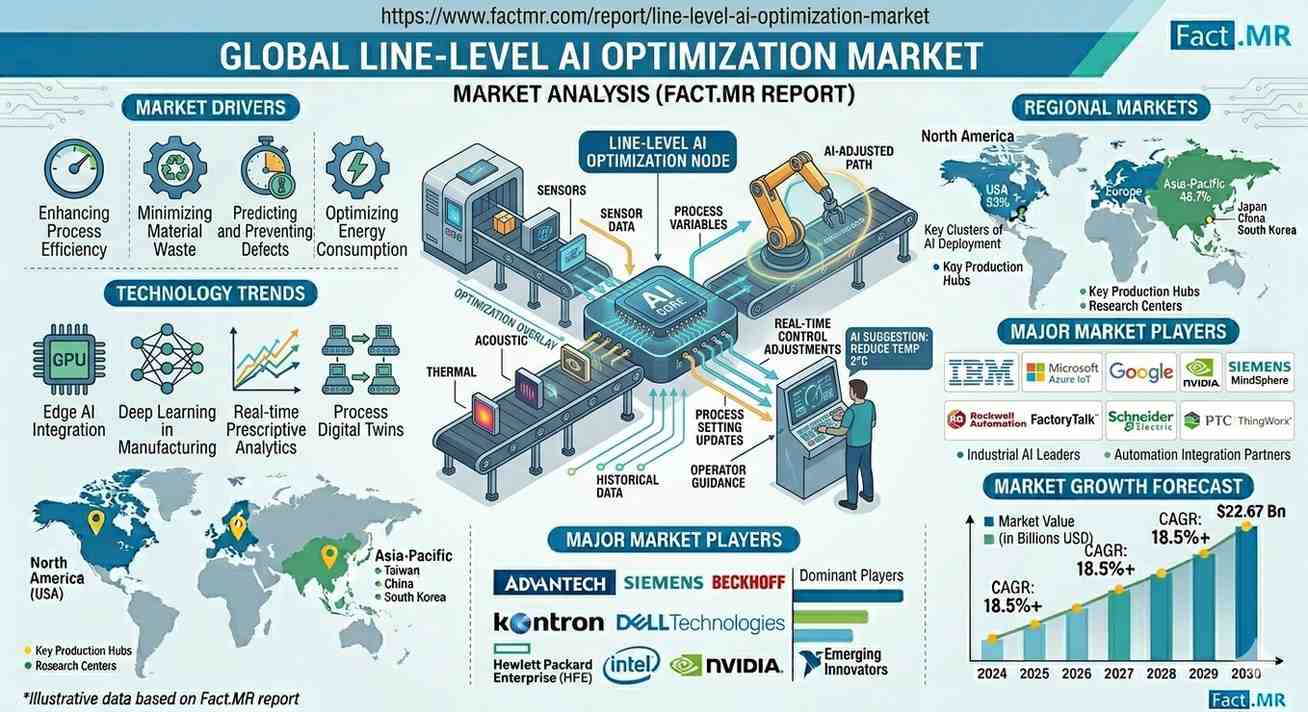
Line-Level AI Optimization Market
Industry 4.0 integration and edge AI drive industrial efficiency gains
ROCKVILLE, MD, UNITED STATES, April 17, 2026 /EINPresswire.com/ -- According to the latest analysis by Fact MR, the Germany Line-Level AI Optimization Market is undergoing a profound structural shift as manufacturers pivot from descriptive analytics to autonomous, closed-loop control systems. Valued at USD 107.1 million in 2026, the market is projected to reach USD 314.2 million by 2036.This growth, representing a steady 8.8% CAGR, is fueled by the aggressive integration of AI within Germany’s established Industrie 4.0 architecture. The transformation is moving beyond human-in-the-loop monitoring, as high-tech manufacturers seek to extract maximum value from capital-intensive assets by modulating machine parameters in real-time to eliminate micro-stoppages and energy waste.
Get detailed market forecasts, competitive benchmarking, and pricing trends:
https://www.factmr.com/connectus/sample?flag=S&rep_id=13548
Quick Stats Section
Market Size (2026): USD 107.1 Million
Market Size (2027 Est.): USD 116.5 Million
Forecast Value (2036): USD 314.2 Million
CAGR (2026–2036):8%
Incremental Opportunity: USD 207.1 Million
Leading Segment: High-speed Packaging Lines (47.3% share)
Leading Region: Western Germany (Industrial Heartland)
Key Players: Siemens AG, Bosch Rexroth AG, Rockwell Automation, Cognex Corporation, SAP SE.
Executive Insight for Decision Makers
The strategic frontier for German manufacturers has moved from "Big Data" to "Actionable Edge Intelligence." For OEMs and Investors, the mandate is clear: AI is no longer a bolt-on software feature but a core component of machine DNA.
Strategic Shift: Moving from predictive maintenance (knowing when it breaks) to prescriptive optimization (ensuring it never slows down).
The Mandate: Manufacturers must invest in high-fidelity, time-synchronized data infrastructure. Without a "clean" data floor, AI algorithms remain ineffective.
Risk of Inertia: Organizations failing to adapt risk a permanent 15-20% gap in OEE (Overall Equipment Effectiveness) compared to AI-optimized peers, leading to uncompetitive unit costs in a high-wage economy.
Market Dynamics
Key Growth Drivers
Labor Shortages & Automation: Extreme pressure on the skilled workforce is driving the need for autonomous "self-healing" production lines.
Energy Decarbonization: AI's ability to optimize speed versus energy consumption is critical for meeting strict German environmental mandates.
Digital Product Passports: The integration of line-level data into regulatory-required product life cycle tracking.
Key Restraints
Legacy Interoperability: The high cost of retrofitting brownfield sites with the sensors required for high-fidelity AI.
Data Sovereignty Concerns: Strict internal protocols regarding the sharing of proprietary process data with cloud-based AI vendors.
Segment Analysis
The High-speed Packaging Lines segment dominates the German market with a 47.3% share. In sectors like pharmaceuticals and FMCG, where lines run at extreme velocities, the ROI for AI is instantaneous; preventing even a 30-second stall translates to thousands of Euros in saved throughput.
AI/ML-based Predictive Optimization remains the largest technology segment (49.0%), acting as the "entry point" for German Mittelstand companies before they graduate to full real-time autonomous control.
Supply Chain Analysis: "Who Supplies Whom"
The ecosystem is a multi-tiered hierarchy of specialized German engineering:
Raw Component Suppliers: Sensor manufacturers (e.g., Sick AG, Balluff) provide the "nervous system."
The "Brains": AI software specialists and platform providers (Siemens, Bosch) create the algorithmic layer.
Integrators: Engineering firms and specialized OEMs (the German "Hidden Champions") embed these AI modules into bespoke machinery.
End-Users: Blue-chip giants in Automotive (VW, BMW) and Pharma (Bayer) are the primary buyers, demanding seamless integration between the factory floor and ERP systems.
Pricing Trends
Pricing is rapidly evolving from a Capital Expenditure (CapEx) model to Outcome-Based Pricing.
Premium Positioning: German solutions command a premium due to high cybersecurity standards and "plug-and-produce" compatibility with existing PLC frameworks.
Margin Insights: Vendors are increasingly offering "Performance-as-a-Service," where fees are tied directly to the measured percentage increase in OEE.
Regional Analysis: The German Landscape
While Germany grows at an 8.8% CAGR, it represents a "mature-innovation" market compared to India’s 14.5%.
Baden-Württemberg & Bavaria: Lead in adoption due to the high density of automotive and precision engineering.
North Rhine-Westphalia: Focused on heavy industrial and chemical process optimization.
Comparison: Unlike emerging markets that focus on volume, Germany’s growth is defined by precision, quality, and regulatory compliance.
Competitive Landscape
The market is consolidated among heavyweights who control the machine controllers.
Siemens AG: Dominates through its "Industrial Operations X" platform, integrating AI directly into the TIA Portal.
Bosch Rexroth: Focuses on modular, open-source AI architectures that allow for flexible manufacturing.
Cognex: Leads the sub-segment of vision-based AI optimization for quality control.
Strategies: The focus is on ecosystem locking—ensuring that once a manufacturer adopts a specific AI framework, the cost of switching is prohibitively high.
Strategic Takeaways
For Manufacturers: Prioritize edge computing to reduce latency; real-time optimization cannot wait for the cloud.
For Investors: Focus on "Pure Play" industrial AI firms that offer middleware capable of bridging legacy hardware with modern ML models.
For Marketers: Position AI not as a "job killer," but as a "quality guarantor" to align with German labor union (Work Councils) expectations.
Future Outlook
By 2036, the German market will transition toward Holistic Line Autonomy. We anticipate a shift where AI doesn't just optimize one machine, but orchestrates the entire factory floor's energy and material flow in response to fluctuating electricity prices and supply chain disruptions. Sustainability will be the primary metric of success, with AI-driven "Green OEE" becoming the industry standard.
Conclusion
The German Line-Level AI Optimization market is at a tipping point. As the country seeks to maintain its status as the world’s factory for high-end goods, the transition to AI-enabled production is no longer optional. It is the definitive bridge between traditional mechanical excellence and the future of digital-first manufacturing.
Why This Market Matters: In an era of volatile energy costs and labor scarcity, line-level AI is the only tool capable of delivering the double-digit productivity gains required to keep German manufacturing globally competitive.
Full Report: Unlock 360° insights for strategic decision making and investment planning-
https://www.factmr.com/checkout/13548
To View Related Report:
AI Adaptive Control Panels Market https://www.factmr.com/report/ai-adaptive-control-panels-market
AI Robotic Maintenance Systems Market https://www.factmr.com/report/ai-robotic-maintenance-systems-market
Aircraft Cabin Environment Sensor Market https://www.factmr.com/report/aircraft-cabin-environment-sensor-market
AI Server Chassis Market https://www.factmr.com/report/ai-server-chassis-market
S. N. Jha
Fact.MR
+1 628-251-1583
email us here
Legal Disclaimer:
EIN Presswire provides this news content "as is" without warranty of any kind. We do not accept any responsibility or liability for the accuracy, content, images, videos, licenses, completeness, legality, or reliability of the information contained in this article. If you have any complaints or copyright issues related to this article, kindly contact the author above.
