

Openapi.com Unveils the Ultimate API for Global Sanction Screening
KYC API
Mitigate risk with a single API call. Detect PEPs and sanctioned entities worldwide in real-time. The smartest way to manage modern compliance.
Effective KYC management requires navigating a crowded API market. Clients must strategically select the specific vendor that best aligns with their unique business needs”
LONDON, BUCKINGHAMSHIRE, UNITED KINGDOM, December 15, 2025 /EINPresswire.com/ -- Within an increasingly fragmented geopolitical scenario, “Due Diligence” is no longer a mere formality for bankers but a necessary survival strategy. The new and intricate regulatory arena has shifted dramatically with the recent introduction of European legislation—namely, the 6th Anti-Money Laundering Directive—and the ruthless extraterritorial enforcement increasingly exercised by the US OFAC.— Alan Andrews
It is no longer just a case of ‘Know Your Customer’ (KYC). Now, with the ‘Know Your Customer’s Customer’ (KYCC) paradigm, it has become essential for an organization to know if a customer’s relative is a Politically Exposed Person (PEP) involved in a financial scandal, or if the ‘beneficial owner’ of a supplier appears on a UN Security Council list.
The scope of interest includes:
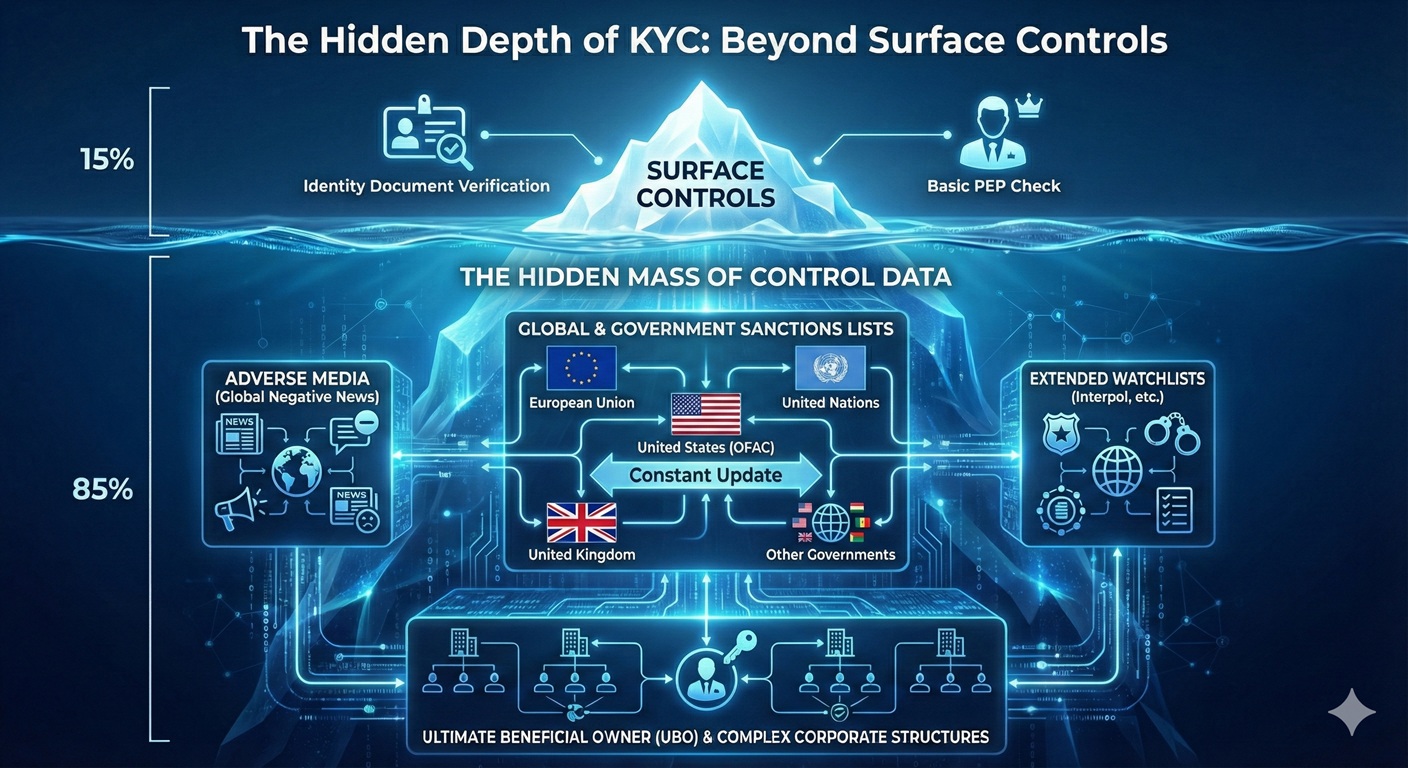
- Sanctions issued by the European Union, United Nations, United States, United Kingdom and other governments
- Lists of individuals linked to terrorism, including terrorist organizations and groups
- Administrative sanctions and measures issued by central banks
- Orders, warnings, and notices from market supervision authorities such as CONSOB, CMNV, FINMA
- Lists of suspended or unauthorized entities and operators
- Lists of interest resulting from international financial scandals such as Panama Papers, Paradise Papers, Pandora Papers
- “Most wanted” individuals lists issued by law enforcement agencies and public safety authorities
The Failure of Static Data
The “Monday Morning” Paradox Until recently, compliance officers would download an Excel or PDF file from a recognized authority (such as Consob, Central Banks, or the FBI). However, relying on downloading static data is now often considered ‘non-compliant’.
“The speed at which an entity ends up on a Sanction List is no longer measured in days but in hours, as a result of rapid geopolitical developments,” attest global risk experts based in the City of London. “What was valid on Monday morning may well be rendered obsolete by Monday evening.” Static information creates a ‘blind spot’ that fails to meet the rigorous standards advised by the FATF.
The RegTech Shift Real-Time APIs The need for these checks has caused the entire RegTech industry to accelerate toward the adoption of Real-Time APIs. A review of the infrastructure set up by modern data vendors, such as OpenAPI.com, shows that verification is no longer a simple request but an instant interrogation across jurisdictions, taking into consideration all regions, including the EU, UK, USA, and UN.
The Hidden Danger: PEPs and “RCAs” Although sanctions imposed on high-profile targets are visible, there is a more insidious risk associated with PEPs. According to current regulations, specifically Article 3 of Directive 2015/849, it is necessary to monitor heads of state and the officials below them. However, scrutiny is arguably even more critical for so-called “RCAs” (Relatives and Close Associates).
The Tech Solution: JSON and ‘Forensic Evidence’ From a technological perspective, beyond mere compliance and audits, retaining ‘Evidence’ of a check becomes a capability issue.
Alan Andrews, a Risk Manager with a major English Fintech, recently analyzed the API calls offered by OpenAPI.com (specifically, the POST /WW-kyc_sanction_list endpoint).
Andrews gave a positive review, highlighting the value of the complex result set. The validation results provide detailed information well beyond a mere “Match/No Match” response, including:
- Unique Sanction ID: Special identifiers (alphanumeric with global scope, e.g., UN-RUS0251 or OFAC-SDN-35096) that link directly to the official source.
- Crime Type: Specific categorization (e.g., Terrorism, Money Laundering, or involvement in global leaks like the Panama Papers and Pandora Papers).
- Similarity Score: A crucial algorithmic measure to eliminate homonyms (solving the "Mario Rossi" or "John Smith" problem), thus significantly lowering costs and false positives.
"Market Outlook and Conclusion Technology is clearly heading in this direction. Although other market participants—such as Dow Jones or Refinitiv—remain necessary for specific benchmarking, it is clear that market practice is evolving towards an API-first strategy"
Given that penalties for violations can reach up to 10% of global turnover (as set forth in recent directives regarding EU Sanctions), integrating these data sets directly into business CRMs is no longer an option, but the only viable alternative to ensure uninterrupted business flow without hampering velocity.
Luca Scuriatti
Openapi Spa
info@openapi.com
Visit us on social media:
LinkedIn
Instagram
Facebook
YouTube
Legal Disclaimer:
EIN Presswire provides this news content "as is" without warranty of any kind. We do not accept any responsibility or liability for the accuracy, content, images, videos, licenses, completeness, legality, or reliability of the information contained in this article. If you have any complaints or copyright issues related to this article, kindly contact the author above.
